

How to Build an Integrated GRC Framework for Energy Companies
A Practical Eight-Step Approach to Connecting Risk, Compliance, Controls and Assurance Across Energy Operations
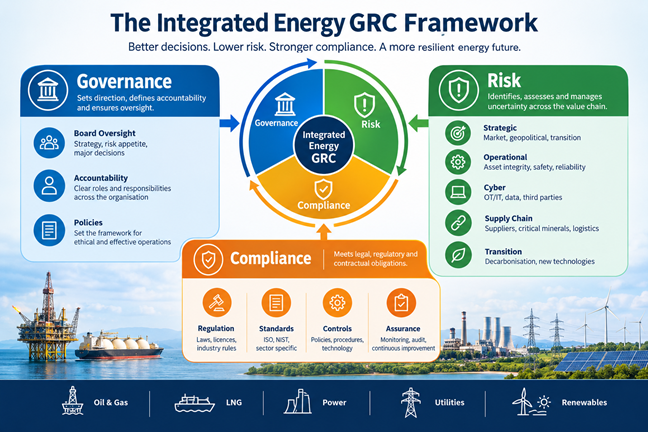
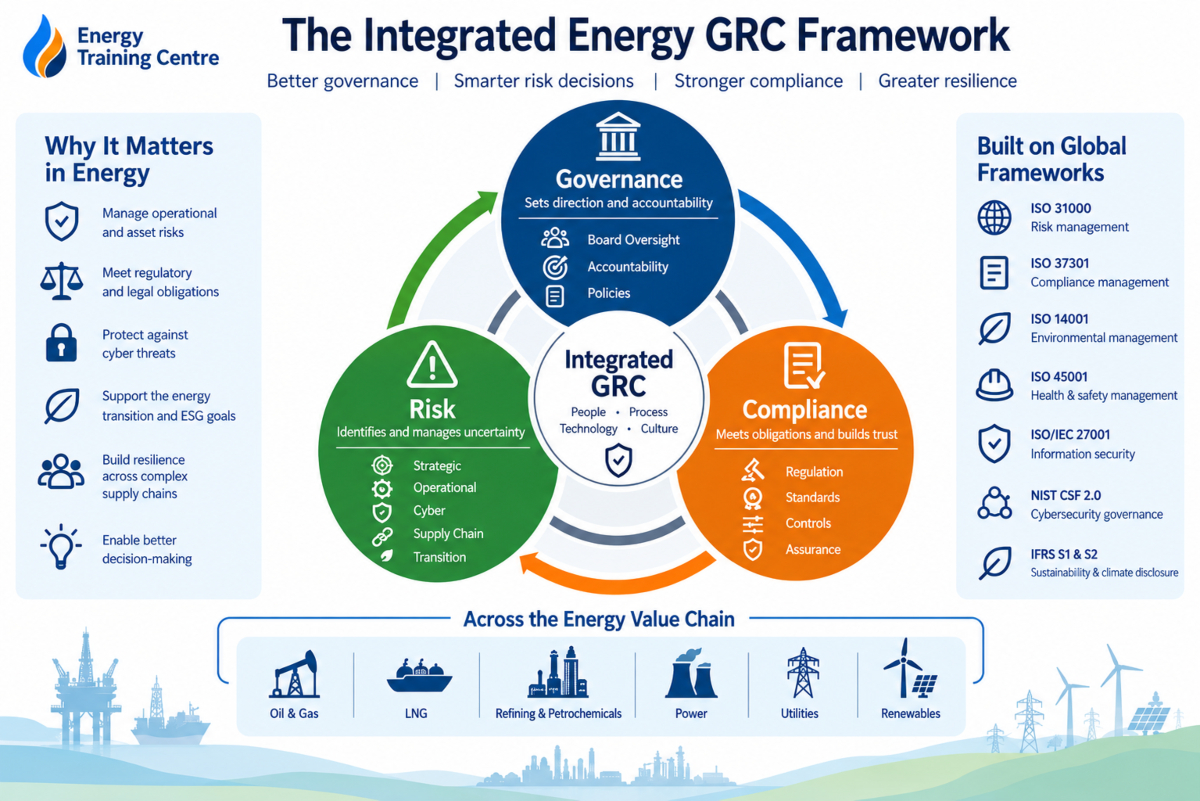
An effective integrated GRC framework should do more than combine risk registers, policies and compliance databases. It should create a traceable connection between business objectives, material risks, regulatory obligations, key controls, assurance activities and management decisions. This connection is particularly important for energy companies. Operational, regulatory, cyber, supply chain, environmental and investment risks are often closely linked. A weakness in one area can quickly affect several others.
This guide presents an eight-step approach for developing an integrated framework across oil and gas, LNG, refining, power, utilities and renewable energy businesses. The aim is not to centralise every specialist function. It is to give decision-makers a coherent view of material exposure. It should also enable them to understand how each exposure is controlled, monitored and assured. Professionals responsible for developing these capabilities can strengthen their practical knowledge through the Governance, Risk and Compliance in the Energy Industry training course.
Key Takeaways
- Start with business objectives and accountability rather than software or compliance registers.
- Use a common risk language so corporate, operational and specialist risks can be compared and escalated.
- Connect material obligations to accountable owners, key controls and supporting evidence.
- Use the Three Lines Model to distinguish risk ownership, specialist oversight and independent assurance.
- Bring cyber, climate, supply chain and other specialist risks into enterprise governance without losing technical expertise.
- Build reporting around decisions, material changes and exceptions rather than the size of the risk register.
- Treat GRC as a continuously improving management system rather than a one-off implementation project.
Why Energy GRC Becomes Fragmented
Most large energy organisations already have enterprise risk management, operational risk registers, HSE systems, compliance teams and cyber risk processes. They may also have sustainability reporting, business continuity arrangements, supplier assurance and internal audit. The difficulty is not usually the absence of these disciplines. Fragmentation occurs because different functions use separate taxonomies, ratings, reporting channels and databases.
One underlying exposure can then appear several times. Dependence on a critical equipment supplier, for example, may be recorded as a procurement risk, operational resilience issue, project risk, financial exposure and regulatory concern. Each assessment may be valid. However, senior management may still lack a consolidated view of the overall exposure.
An integrated framework does not force all functions into one team. It creates enough consistency for information to move between them and support better decisions. Organisations seeking broader capability development can explore specialist corporate governance and compliance courses for energy professionals.
Step 1: Establish the GRC Mandate and Governance
Do not begin with software. Begin with purpose, authority and accountability.
Senior management should define what the initiative is expected to improve. They should also determine who is accountable for implementation, oversight and ongoing development. The mandate may focus on:
- Better visibility of enterprise risk
- Stronger regulatory compliance
- Clearer control ownership
- Reduced duplication of assurance activities
- Closer integration of cybersecurity and enterprise risk
- Improved board and executive reporting
- Greater consistency across operating companies and assets
The mandate should also establish decision rights. This includes who accepts risk, who approves exceptions and who escalates exposures that exceed risk appetite.
Step 2: Map Objectives and Critical Processes
GRC becomes more valuable when risk assessment begins with organisational objectives. It should not begin with a generic list of possible risks.
For an energy company, critical objectives may include maintaining safe production, protecting its licence to operate and ensuring grid reliability. Other priorities may involve delivering capital projects, securing critical supplies, protecting operational technology or managing energy transition investments.
The organisation should identify the processes, assets, systems and third parties that support each objective. This mapping provides the foundation for identifying material risks and regulatory dependencies. It also prevents teams from importing large risk libraries that may have little relevance to actual operations.
Step 3: Create a Common Risk Architecture
An organisation does not necessarily need a single risk register. However, it needs enough consistency to compare, aggregate and escalate material risks. A common architecture may include:
- Strategic and geopolitical risk
- Operational and asset risk
- Health, safety and environmental risk
- Financial and commercial risk
- Regulatory and compliance risk
- Cyber and technology risk
- Supply chain risk
- Project and investment risk
- Sustainability and transition risk
Where practical, the organisation should standardise risk definitions, ownership requirements and likelihood scales. It should also align impact criteria, escalation thresholds, time horizons and risk appetite terminology.
ISO 31000:2018 supports this enterprise-wide approach. It presents risk management as an activity integrated with governance, strategy, planning, reporting, policies and organisational culture.
For a broader explanation of the discipline and its relevance to the sector, read what GRC means for energy organisations and why it matters.
Step 4: Turn Regulations Into an Obligations Architecture
A regulatory library is not the same as effective compliance management. A list of laws and standards has limited value unless each requirement is connected to practical responsibilities and controls. For every material obligation, the organisation should be able to identify:
- The applicable requirement
- The business units, assets or jurisdictions affected
- The accountable owner
- The relevant process
- The control that satisfies the requirement
- The evidence that must be retained
- The method used to monitor compliance
- The escalation route for non-compliance
ISO 37301:2021 provides an international management system framework for establishing, implementing, evaluating, maintaining and improving compliance management. Specialist governance and regulatory compliance training courses can help professionals connect these requirements with organisational responsibilities, ethical conduct and effective oversight.
Step 5: Identify the Controls That Really Matter
Large organisations can accumulate thousands of controls. Treating every activity as equally important makes oversight difficult and reduces the value of assurance.
A mature framework distinguishes routine activities from key controls. These are controls whose failure could materially increase exposure or lead to significant non-compliance. Each key control should include:
- The risk or obligation being addressed
- A clear control objective
- An accountable owner
- The required frequency
- Evidence of performance
- Defined performance criteria
- A monitoring method
- An escalation requirement
This structure makes it easier to test whether a control is appropriately designed and operating as intended.
Step 6: Bring Specialist Risks Into Enterprise GRC
Integration should not dilute specialist expertise. Cybersecurity, HSE, sustainability, engineering and other technical functions should retain the methods required for their disciplines.
However, material risks from these areas should enter enterprise governance through a common escalation route. A major operational technology vulnerability, for example, should not remain within a technical dashboard if it could affect production, safety, regulatory compliance or financial performance.
Common impact criteria and escalation thresholds help specialist teams communicate risk in terms that senior management can compare and act upon. Professionals who need to connect technical risks with executive oversight can benefit from focused GRC capability development for the energy sector training course.
Step 7: Define the Three Lines and Build an Assurance Map
The Three Lines Model helps clarify the roles of management, specialist oversight functions and internal audit.
Operational management owns and manages risk. Specialist functions provide expertise, support, monitoring and challenge. Internal audit provides independent assurance to the governing body. An assurance map should connect principal risks and key controls with the different assurance providers. This makes it easier to identify:
- Risks receiving insufficient assurance
- Areas subject to repeated or duplicated reviews
- Conflicting assurance conclusions
- Gaps in regulatory or control coverage
- Opportunities for coordinated assurance planning
The objective is not to eliminate overlap completely. It is to ensure that overlap is deliberate and proportionate to the exposure.
Step 8: Turn GRC Reporting Into Management Decisions
A board or executive committee should not have to interpret a large operational risk register. Reports should direct attention towards matters requiring judgement, intervention or formal acceptance.
Useful reporting should highlight:
- Material changes in exposure
- Risks outside approved appetite
- Significant key control weaknesses
- Regulatory breaches or exceptions
- Emerging and interconnected risks
- Overdue high-priority actions
- Important assurance findings
- Decisions requiring executive escalation
Reports should explain why an issue matters, what has changed and what action is required. This turns GRC reporting from a record-keeping exercise into a practical management tool.
Where GRC Technology Adds Value
Technology becomes valuable after governance, taxonomies, ownership and key processes have been sufficiently defined.
It can then support:
- Obligations libraries
- Risk and control mapping
- Approval workflows
- Evidence collection
- Issue and action tracking
- Regulatory change monitoring
- Management dashboards
- Assurance coordination
Technology cannot resolve unclear accountability or inconsistent risk definitions. Automating a fragmented process may simply make the fragmentation faster and more visible.
How to Measure Whether GRC Is Working
A successful framework should improve behaviour and decisions. It should not simply increase the number of records stored in a system.
Useful indicators include:
- Fewer duplicated risk assessments
- Clearer risk and control ownership
- Faster escalation of significant issues
- Better visibility of material obligations
- Fewer overdue high-priority actions
- More complete assurance coverage of principal risks
- More consistent risk information across business units
- Evidence that risk information influences investment, operational or strategic decisions
An integrated GRC framework is effective when it helps leaders understand material exposure and make better-informed decisions. It should connect objectives, risks, obligations, controls and assurance without removing the specialist knowledge required across the energy industry.

Popular Training Venues

Popular Training Categories




Explore More Training Insights
Discover expert tips, industry trends, and best practices to enhance your professional development journey.
View All Articles