

GRC in Energy: What It Means and Why It Matters
A practical guide to integrated governance, risk management and compliance across oil and gas, power, utilities and renewable energy
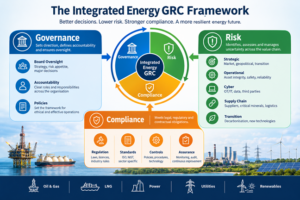
Governance, Risk and Compliance (GRC) provides energy organisations with an integrated way to make accountable decisions, manage uncertainty and meet regulatory obligations.
For oil and gas companies, power producers, utilities and renewable energy businesses, this is increasingly important. The sector is dealing simultaneously with operational hazards, cyber threats, supply-chain concentration, geopolitical uncertainty, regulatory change, sustainability expectations and the transformation of global energy systems. Professionals looking to build these skills in depth can explore our Governance, Risk, and Compliance (GRC) in the Energy Industry course, which covers the frameworks and practices outlined below.
The International Energy Agency (IEA) describes today’s energy-security environment as extending well beyond traditional oil and gas supply concerns. Electricity infrastructure is increasingly exposed to cyber, operational and weather-related hazards, while critical-mineral supply chains have become strategically important. The IEA reports that recent annual operational disruptions to critical energy infrastructure affected energy supplies to more than 200 million households worldwide. (IEA, World Energy Outlook 2025)
GRC therefore should not be seen simply as a compliance function. At its best, it connects board oversight, management accountability, enterprise risk, regulatory obligations, controls and assurance so that an organisation can make better decisions and remain resilient when conditions change. For a broader view of related training options, see our Corporate Governance and Compliance (GRC) Training Courses.
Key Takeaways
- GRC connects governance, risk management and compliance rather than managing them as separate functions.
- Energy-sector GRC must address operational, regulatory, cyber, environmental, financial, geopolitical and supply-chain risks.
- International frameworks including ISO 31000, ISO 37301 and NIST CSF 2.0 can support a structured approach.
- Public disclosures from Saudi Aramco, ADNOC Gas, Shell, Equinor and DEWA illustrate how energy organisations connect board oversight with risk, internal controls and sustainability.
- Effective GRC is moving beyond compliance monitoring towards risk-informed decision-making and organisational resilience.
Explore our full range of Corporate Governance and Compliance (GRC) Training Courses to find the right programme for your role and industry.
What Does Governance, Risk and Compliance Mean?
The three elements of GRC perform different but closely connected roles.
Governance defines how an organisation is directed and controlled. It establishes accountability, decision rights, policies, oversight and reporting from the board through executive management to operational functions. Risk management identifies and evaluates uncertainty that could affect objectives. In energy businesses this can range from operational and safety risks to commodity-market, cyber, regulatory, environmental and geopolitical exposure.
Compliance establishes how the organisation identifies and meets applicable laws, regulations, licences, standards, contractual commitments and internal policies. A mature GRC model brings these disciplines together. Instead of risk teams, compliance functions, internal audit, cybersecurity specialists and operational managers working through separate systems, the organisation develops a more consistent view of:
Objectives → Risks → Obligations → Controls → Assurance → Reporting → Decisions
That connection is particularly valuable in energy organisations where one incident can quickly cross several risk categories. A cyberattack on operational technology, for example, may begin as a technology event but become an operational, safety, regulatory, financial and reputational issue.
Why GRC is Different in the Energy Industry
Energy companies operate critical infrastructure, capital-intensive assets and complex supply chains, often across multiple jurisdictions. The potential consequences of control failure are correspondingly significant, affecting employees, communities, customers, regulators, investors, energy markets and essential infrastructure.
- Operational and Asset Risk: Facilities such as refineries, production platforms, pipelines, power stations, electricity networks and LNG plants require effective asset integrity, maintenance, safety and operational-control systems.
- Regulatory Complexity: Energy businesses may face requirements covering licensing, market conduct, health and safety, environmental protection, emissions, financial reporting, competition, cybersecurity, data, sanctions and industry-specific regulations.
- Critical Infrastructure and Cybersecurity: Greater connectivity between information technology and operational technology creates efficiency opportunities but also introduces cyber risks capable of affecting physical operations.
- Energy Transition: Changes in technology, markets and policy are altering investment decisions and business models across conventional and emerging energy.
- Geopolitical and Supply-Chain Exposure: Equipment, technology, critical minerals and specialist services may come from highly concentrated or internationally exposed supply chains.
The IEA’s State of Energy Policy 2026 reported that 11 of 20 critical minerals it identifies as essential to the energy sector were subject to export controls at some point during 2025. GRC helps management understand these issues as connected business risks rather than isolated departmental problems.
Governance and Risk in Practice
At board level, governance typically covers oversight of strategy, risk appetite, major investments, internal controls and sustainability matters. Executive management translates this into policies and performance expectations, while operational management manages risk where activities actually happen. Risk, compliance and cybersecurity functions provide frameworks and challenge; internal audit provides independent assurance.
Energy risk rarely sits in a single category. A shortage of specialist equipment can start as a procurement issue, then affect maintenance, production, contracts and regulatory obligations. ISO 31000:2018 supports this joined-up approach, emphasising that risk management should be built into governance, strategy and culture — not treated as a standalone exercise.
Compliance as a Management System
Effective compliance goes beyond maintaining a register of regulations. It should help the organisation understand which obligations apply, assign accountable owners, monitor performance and escalate significant issues. ISO 37301:2021 provides an international framework for this, which becomes especially useful for organisations operating across several jurisdictions with differing requirements.
Cybersecurity as a Governance Issue
Cybersecurity can no longer sit purely with IT. Boards increasingly need to understand who owns cyber risk, what level of risk is acceptable, and how effectively the organisation can respond and recover. NIST CSF 2.0 reflects this shift by adding Govern as a core function alongside Identify, Protect, Detect, Respond and Recover.
GRC, Sustainability and the Energy Transition
Energy transition raises new governance questions: who approves major transition investments, how climate risk is built into enterprise risk management, and whether public disclosures are backed by proper controls. The IFRS S1 and S2 Sustainability Disclosure Standards reflect this shift, organising disclosures around governance, strategy, risk management, and metrics and targets — though adoption still depends on local jurisdiction.
Common Weaknesses
Several issues repeatedly weaken GRC in practice: fragmented risk assessments across departments, excessive focus on documentation over real accountability, and poor escalation, where important information fails to reach senior management in time to act. A mature GRC framework should simplify decision-making, not add to the noise.
Looking Ahead
Energy systems are becoming more digital, interconnected and exposed to new risks, from extreme weather to cyberattacks to concentrated mineral supply chains. For GRC professionals, the future lies less in compliance administration and more in connecting risk intelligence with strategy, cybersecurity with enterprise risk, and sustainability with governance — helping organisations recognise change earlier and respond more effectively when disruption occurs.
Ready to build these skills further? Join our Governance, Risk, and Compliance (GRC) in the Energy Industry course and learn how to apply GRC frameworks directly to your organisation.

Popular Training Venues

Popular Training Categories




Explore More Training Insights
Discover expert tips, industry trends, and best practices to enhance your professional development journey.
View All Articles